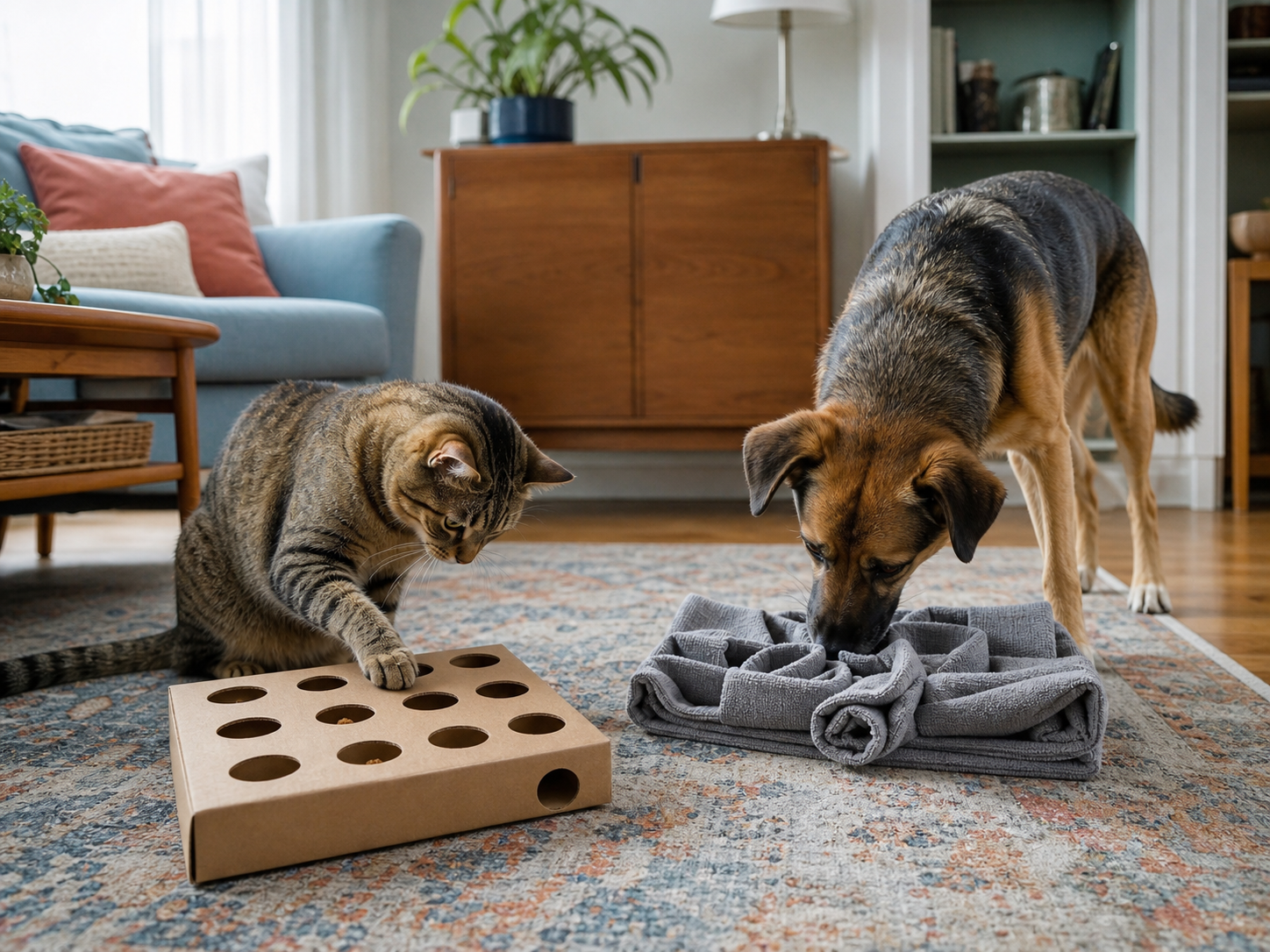
Novelty can return after a break, but only if each active set still offers useful variety: chase, chew, tug, forage, bat, or carry. By the end, you will have a small setup or routine you can repeat, observe, and adjust without pushing your pet through discomfort.
Complete six short steps in order. Keep the environment stable, watch your pet's response, and stop at the last version that still feels easy.
Choose reliable anchors
Sort toys by function and choose a compact active set that covers the behaviors your pet actually enjoys.
Define the behavior in observable terms before trying to change it. Describe what the body did, where it happened, and what occurred immediately before and after.
What happened immediately before the response, and what changed when difficulty was reduced?
Store clean, dry toys out of sight in a closed container. Do not rotate damaged items back into use.
Lower difficulty until your pet can stay engaged without frantic movement, freezing, hiding, or repeated attempts to escape.
Did you change only one meaningful variable during this attempt?
Build a repeatable rhythm
Change one or two toys every week rather than replacing everything at once, preserving a familiar favorite.
Reinforce the alternative you actually want, such as moving to a mat, sniffing, scratching an approved surface, or taking distance.
Can you identify an obvious stopping point before discomfort or frustration appears?
Present the returning toy through interaction. A toy on the floor is less interesting than one that moves or starts a shared game.
Keep enrichment easy enough to solve. Frustration, guarding, or escalating arousal means the activity needs to be simplified or stopped.
Does the setup still provide easy access to rest, water, food, toileting, and retreat?
When the day changes
Keep high-arousal or edible toys for supervised sessions and put them away before conflict or fatigue develops.
Repeat in short sessions across several ordinary days and look for a trend. One unusually good or difficult attempt is not the full pattern.
Would a veterinarian or qualified behavior professional have enough observations to understand the pattern?
Track what gets used. Donate safe, washable items your pet consistently ignores rather than maintaining decorative clutter.
If behavior changes suddenly or affects eating, sleep, movement, elimination, or safety, involve a veterinarian before treating it as a training issue.
Can your pet pause, move away, and return without being guided or restrained?
Common mistakes
- Using labels such as stubborn or jealous instead of recording observable behavior.
- Making enrichment so difficult that it produces frustration rather than useful engagement.
- Assuming a sudden behavior change is purely a training problem.
Complete the lesson
Use one ordinary situation from your own home and make a short observation record for “Toy Rotation: Less Clutter, Better Play.”
- Prepare the easiest safe version before inviting your pet to participate.
- Complete only the first two steps and record body language, appetite, movement, or recovery.
- Repeat on another day before increasing difficulty.
- Write one sentence describing what you will keep, simplify, or ask a professional about.
Health and safety note
Petinya provides general educational information. Sudden behavior change, pain, breathing difficulty, collapse, injury, inability to eat or drink, urinary trouble, or persistent distress needs prompt professional veterinary advice.
Key takeaway
Keep a small active set, store the rest, and rotate by play style instead of buying a new toy whenever interest fades. Keep the environment predictable, let your pet communicate, and choose changes small enough that both of you can repeat them. Clear observations will always be more useful than trying to meet someone else's timeline.